Scientists Develop Nanowire-Integrated MOFs for Pollutant Removal
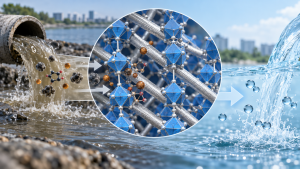
Scientists at the Institute of Advanced Study in Science and Technology (IASST), Guwahati, developed a metallic nanowire-integrated material for sunlight-driven pollutant degradation. The findings were reported on 23 November 2026.
Hybrid material targets pyrene
The material combines copper nanowires confined within isoreticular metal–organic framework-8 (IRMOF-8). Adding palladium nanostructures enhanced light absorption and photocatalytic activity, removing 99% of the targeted pollutant, pyrene. Aluminium was also tested as a lower-cost alternative, achieving 85% removal under the investigated irradiation and ultrasonication conditions. Pyrene is a persistent, toxic polycyclic aromatic hydrocarbon that is difficult to remediate.
Research team and publication
The study was led by Professor Devasish Chowdhury and PhD scholar Netra Prova Baruah. It was published in ACS Applied Energy Materials.
Important Facts for Exams
- Framework construction: Metal–organic frameworks combine metal nodes or clusters with organic linkers to form extended structures that are often porous.
- Pore engineering: Changing MOF pore dimensions, linker chemistry and surface groups can control which molecules enter and how they interact with the framework.
- Nanoscale confinement: In nanowires, lateral quantum confinement gives electrons energy levels unlike the continuous bands characteristic of bulk materials.
- PAH ring pattern: Pyrene is the smallest peri-fused polycyclic aromatic hydrocarbon; its rings are fused through more than one face.
| Related | |
|---|---|