Pakistan Tests Indigenous Fa'az Air-to-Air Missile
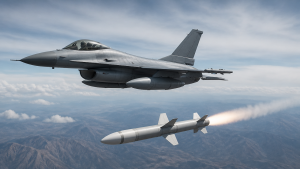
Pakistan conducted a flight test of its first indigenously developed Fa'az air-to-air missile on 3 November 2026. The missile was launched from a JF-17 Thunder aircraft.
Missile development and reported variants
The missile has an advanced terminal guidance system designed to track and engage aerial targets at extended ranges. Analysts have identified the tested configuration as FAAZ-IIR, reportedly using imaging infrared guidance with a detection range of about 40 kilometres; official confirmation of the variant is pending. Proposed family members include the FAAZ-RF, described as an active-radar-homing missile with a range exceeding 100 kilometres and a maximum speed of Mach 3.5, and the FAAZ-2, which is under development for a reported range of 180–200 kilometres or more.
Developers and official response
The Air Weapons Complex, operating under the National Engineering and Scientific Commission (NESCOM), is identified as the principal developer; Global Industrial and Defence Solutions (GIDS) markets the missile family. Some reports describe Fa'az as a licence-built version of China's PL-9C, while official statements describe it as indigenous. President Asif Ali Zardari, Prime Minister Shehbaz Sharif and military leaders, including Army Chief Field Marshal Syed Asim Munir, congratulated the scientists and engineers. Pakistan has stated that domestic development aims to increase the Pakistan Air Force's operational flexibility and reduce reliance on foreign weapons. The test followed an October 2026 test launch of an extended-range Fatah-2 ballistic missile.
Important Facts for Exams
- Imaging-infrared seeker: Imaging-infrared air-to-air seekers form an image-like view of a target and can distinguish aircraft from point heat sources such as flares.
- Active radar homing: Active-radar-homing missiles carry their own radar to detect and track targets, allowing the launching aircraft to leave after firing.
- Developer oversight: The Air Weapons Complex receives weapons-development direction from the air force but is managed and operated as a division under civilian NESCOM.
| Related | |
|---|---|