New Parasitic Wasp Species Found in Dibru-Saikhowa
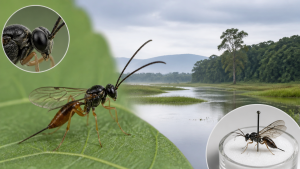
A new parasitic wasp species, Oxyserphus narendrani, was discovered on 22 September 2026 in Dibru-Saikhowa National Park in Assam. The species was identified by scientists from the Zoological Survey of India through microscopic characters, including a single horizontal groove on the thorax, a shorter ovipositor sheath, and a distinctive wing spot.
Taxonomy and Identification
Oxyserphus narendrani belongs to the genus Oxyserphus, which is recorded for the first time from the Oriental region through this finding. The insect measures about 3.3 millimetres and has a black head, a brownish-black body, and yellow legs.
The specimen was collected with a yellow pan trap, which is a simple passive trapping device used in insect surveys. The genus Oxyserphus is generally associated with high-altitude areas and is rare in global insect collections.
Dibru-Saikhowa National Park
Dibru-Saikhowa National Park lies in the Dibrugarh and Tinsukia districts of Assam. The park contains moist mixed semi-evergreen forests, deciduous forests, canebrakes, and grasslands.
The park is part of the Brahmaputra floodplain ecosystem and is known for its wetland and grassland habitats. Such habitats support a wide range of insects, birds, and other fauna.
Parasitic Wasps and Biological Control
Parasitic wasps are insects that lay eggs inside or on other insects, and many species act as egg-larval parasitoids. Their hosts often include moths and butterflies, which places them in the order Lepidoptera.
These wasps are studied in biological control because they help regulate pest populations in agricultural ecosystems. Their role is relevant to sustainable agriculture and integrated pest management.
Important Facts for Exams
- Oxyserphus narendrani is a parasitic wasp species discovered in Assam in 2026.
- Dibru-Saikhowa National Park is located in the Dibrugarh and Tinsukia districts of Assam.
- Yellow pan traps are used in entomological surveys to collect small insects.
- Parasitic wasps often act as natural enemies of moth and butterfly pests.
Related Discovery in Assam
A separate parasitic wasp, Chelonus (Carinichelonus) mahadeb, was discovered on 14 March 2026 in the Nahortoli Tea Estate in Assam. The discovery involved researchers from the Zoological Survey of India, the Centre for Biodiversity Genomics at the University of Guelph, and the Kalinga Foundation.
| Related | |
|---|---|