L&T Secures 300 MW Battery Storage Order in Khavda
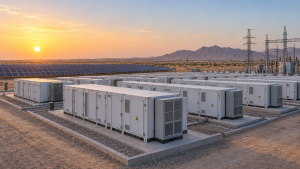
On November 25, 2026, Larsen & Toubro (L&T) secured an order to develop a 300 MW/900 MWh Battery Energy Storage System (BESS) at Khavda in Gujarat. The order involves its Renewables and L&T Electronic Products & Systems businesses.
L&T’s three-hour storage project
The system will store surplus renewable energy and release it during peak demand, supporting grid stability and reliability. It will use liquid-cooling technology, designed to provide higher power density, improved safety and longer operational life. L&T classified the order as “significant”, a category valued between ₹1,000 crore and ₹2,500 crore.
Adani’s Khavda storage expansion
Separately, Adani Green Energy Ltd commissioned 3.37 GWh of battery storage at Khavda by May 26, 2026. The deployment was described as the world’s largest single-location battery storage project outside China and was completed within 10 months of on-site construction. By October 1, the company’s operational capacity at Khavda had reached 6.63 GWh. It plans to add more than 10 GWh in fiscal year 2027 and scale capacity to 50 GWh over the next five years at the Khavda Renewable Energy Park.
Important Facts for Exams
- Grid-response speed: Battery storage can move from standby to full power in under a second, helping address sudden grid contingencies.
- Rated discharge duration: Battery energy storage systems generally deliver full rated power for one to four hours, although emerging technologies can extend this duration.
- AC grid interface: Batteries store and release direct current, while electricity networks usually operate on alternating current, so grid connections require inverters.
- Shared grid connection: Storage plants sited beside operating or retired power stations may share their grid connection, reducing connection costs.
| Related | |
|---|---|