India’s First Chief Justices of India Museum Opens at JGU
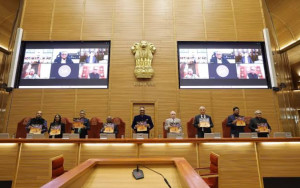
India’s first Chief Justices of India Museum, titled “Guardians of the Republic”, was inaugurated at O.P. Jindal Global University (JGU) in Sonipat, Haryana, on 26 November 2026. The event description also places the inauguration a day before Constitution Day, observed on 26 November; these dates conflict.
Museum exhibits and participants
Ten former Chief Justices of India (CJIs) attended in person or virtually: M.N. Venkatachaliah, B.N. Kirpal, S. Rajendra Babu, K.G. Balakrishnan, P. Sathasivam, R.M. Lodha, Dipak Misra, S.A. Bobde, U.U. Lalit and B.R. Gavai.
Spread across five galleries, the museum features more than 280 busts of Supreme Court judges, models of 25 High Courts, 22 language tapestries and 20 interactive pillars on the lives of CJIs. It also presents 20 landmark judgments, a holographic courtroom, artworks, sculptures and an oral-history project featuring former CJIs and judges. Its stated aim is to document former CJIs’ contributions and trace the Supreme Court’s evolution alongside India’s constitutional framework.
At the event, B.R. Gavai said the court during his tenure worked to provide representation to Scheduled Castes, Scheduled Tribes, minorities and women.
Important Facts for Exams
- Appointment process: The President appoints the Chief Justice on the outgoing Chief Justice’s recommendation, made in consultation with other Supreme Court judges.
- Bench formation: The Chief Justice allocates cases and appoints constitutional benches to address important legal questions or interpret the Constitution.
- Court jurisdiction: The Supreme Court exercises original, appellate and advisory jurisdiction; the President may refer matters to it for advisory consideration.
| Related | |
|---|---|