TAPI Pipeline Section to Herat Targets 2026 Completion
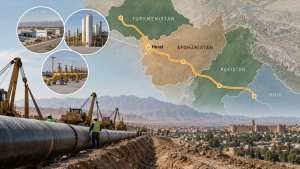
The Afghan section of the Turkmenistan-Afghanistan-Pakistan-India (TAPI) gas pipeline is advancing towards Herat. Turkmenistan expects to complete the 153-kilometre Serhetabat-Herat section by the end of 2026, with gas supplies to Herat targeted to begin in early 2027.
Construction and planned use
As of November 2026, about 124 kilometres—around 80–81% of the section—had been welded and laid. At the Turkmen Energy Forum in October, officials said the route had reached Herat’s outskirts. Construction of the Afghan section began in 2024, after Turkmenistan completed its domestic section in 2019. Afghan media estimate the Serhetabat-Herat stretch will cost about US$600 million.
Initial supplies are intended for domestic use, including connections to the Herat Industrial Park, gas distribution stations and a compressed natural gas complex. A private investor has proposed a gas-fired power plant near Herat. TAPI project head Muhammetmyrat Amanov expects commissioning to generate early revenue and build lender confidence for the wider US$10 billion project. Geopolitical tensions, security concerns and financing constraints remain obstacles; the Asian Development Bank has suspended regular assistance to Afghanistan.
Important Facts for Exams
- Capacity allocation: TAPI is designed to carry 33 billion cubic metres of natural gas annually: Afghanistan is allocated five billion, while Pakistan and India each receive 14 billion.
- Export-route rationale: TAPI emerged as an independent export-route option after pipeline operators were denied access to Russian networks; its route also avoids Iran.
- Afghan corridor: The Afghan section is planned alongside the Kandahar–Herat Highway, continuing through Quetta and Multan in Pakistan towards Fazilka in India.
- Project developer: Galkynysh–TAPI Pipeline Company Limited is developing the pipeline with participation from the Asian Development Bank.
| Related | |
|---|---|