Ice Cores: Formation, Climate Records and Scientific Importance
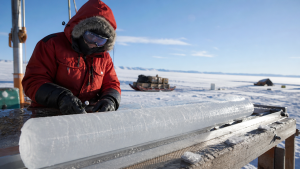
Ice cores are cylinders drilled from glaciers and ice sheets, preserving layered evidence of past climate and atmospheric conditions. Their ice and trapped air provide distinct records that help scientists reconstruct environmental change over thousands of years.
Formation of Ice Cores
In polar regions and high-altitude glaciers, successive snowfall accumulates in layers. The weight of newer snow compresses older snow into firn, a granular, porous material, and eventually into dense glacial ice. Small air bubbles become sealed within the ice as it forms, preserving samples of the atmosphere at the time of burial. In an undisturbed ice core, deeper layers are generally older, but the relationship is affected by ice flow and compression. Layers become thinner with depth, making age estimates more difficult in very old ice. Ice sheets in Antarctica and Greenland are major drilling locations because of their extensive, stable ice masses; mountain glaciers also preserve valuable regional records.
- Layer formation: Annual snowfall can create successive layers that record changing environmental conditions.
- Firn and ice: Compaction transforms porous firn into dense ice, trapping air and particles.
- Ice-core sites: Polar ice sheets and high-altitude glaciers provide records from different environments.
What Ice Cores Record
Ice cores contain direct samples and environmental proxies. Their contents can reveal atmospheric composition, temperature patterns, volcanic activity, atmospheric transport and other changes. The evidence is interpreted together because each measurement records a different aspect of the past environment.
- Trapped gases: Air bubbles preserve past atmospheric composition, including carbon dioxide (CO2), methane (CH4) and nitrous oxide (N2O). These measurements help establish how greenhouse-gas concentrations changed over time.
- Stable isotopes: Ratios of oxygen isotopes, such as oxygen-18 to oxygen-16, and hydrogen isotopes, including deuterium to hydrogen, are related to conditions when the snow fell. They are used as indicators of past temperature and environmental conditions.
- Dust and particles: Dust, volcanic ash, sea salts and pollen can indicate atmospheric circulation, aridity, eruptions and vegetation changes.
- Chemical ions: Sulfate and nitrate concentrations can provide evidence of volcanic events, forest fires and marine biological activity. Non-sea-salt ions can also help identify continental dust sources and atmospheric transport.
- Radioactive elements: Naturally occurring radioactive elements, as well as those associated with nuclear testing, can help date particular ice layers.
Analysis and Dating
Different analytical methods are used to examine the ice, its gases and the particles or chemicals it contains. Dating is essential for placing these measurements in sequence. The age assigned to the ice itself may differ from the age of gases trapped within it, so ice and gas chronologies are treated separately.
- Isotopic analysis: Mass spectrometry measures oxygen and hydrogen isotope ratios used to reconstruct past temperature and environmental conditions.
- Gas analysis: Ice is processed to release trapped air; gas chromatography and mass spectrometry measure greenhouse gases and other atmospheric components.
- Particle and chemical analysis: Microscopes and lasers examine dust characteristics, while ion chromatography measures chemical species such as sulfate and nitrate.
- Electrical conductivity: Electrical conductivity measurements can identify changes through the ice, including acidic layers associated with volcanic ash.
- Dating approaches: Annual layers may be counted in shallower ice, while ice-flow models estimate the ages of deeper, deformed and thinned layers. Radioactive isotopes, including beryllium and chlorine, can date ice; geomagnetic events can provide additional chronological markers.
Scientific Importance
Ice-core evidence helps reconstruct long-term climate variability, including glacial and interglacial periods and abrupt shifts. Direct measurements of gases provide records of past greenhouse-gas concentrations and help establish pre-industrial baselines. Together, isotope and gas records inform research into the relationship between atmospheric composition and climate. Volcanic ash and sulfate spikes preserve evidence of eruptions that can have short-term cooling effects. Changes in dust flux and composition can indicate shifts in wind patterns and aridity in source regions. Cosmogenic beryllium-10 can serve as a proxy for past solar activity. Such records support assessments of climate sensitivity and strengthen climate science capacity and environmental monitoring.
- Climate history: Isotope records help identify past temperature changes and major climate intervals.
- Atmospheric history: Trapped gases provide direct evidence of past greenhouse-gas concentrations.
- Environmental signals: Dust, ash and chemical layers reveal changes in circulation, aridity and volcanic activity.
- Research capacity: Maintaining ice-core research and analytical expertise contributes to scientific institutions’ ability to monitor environmental change.
Key Prelims Takeaways
- Ice cores form as accumulated snow compacts first into firn and then into glacial ice.
- Air bubbles preserve samples of ancient atmosphere, including greenhouse gases.
- Oxygen and hydrogen isotope ratios are used to reconstruct past temperature and environmental conditions.
- Ice and gases trapped within it have separate age chronologies.
- Dating methods include layer counting, ice-flow modelling, radioactive isotopes and geomagnetic markers.
- The Laschamp Geomagnetic Excursion was a brief reversal of Earth’s magnetic field, dated to 42,200–41,500 years ago.
Recent Context
A study published in Science Advances in late September or early October 2026 reports that Tibet’s Guliya Plateau ice may preserve a climate record extending beyond 128,000 years. This extends the known regional glacial record by over 100,000 years; Guliya is now considered the oldest identified mountain ice record outside the polar regions.
| Related | |
|---|---|