China Launches Gravity-1 Rocket with Nine Satellites
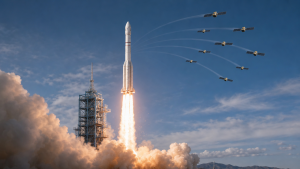
China launched the Gravity-1 carrier rocket on 22 July 2026 and placed nine satellites into their designated orbits. The launch took place at 10:54 a.m. Beijing time from a maritime platform in the East China Sea, east of Shanghai.
Gravity-1 Rocket
Gravity-1 is a solid-fuel carrier rocket developed by Orienspace, a private Chinese commercial launch company. The rocket is described as the world’s most powerful solid-fuel rocket. The Gravity-1 series completed its third successful flight with this mission.
Satellite Payload
The nine satellites included Dongpo-13, Dongpo-14, Dongpo-17, Dongpo-18, Dongpo-19, Dongpo-20, Xiguang-2 01, Tianyi-49, and Lilac-3, which is also called Zidingxiang-3. The Dongpo satellites are designed for all-weather and all-time Earth observation. Xiguang-2 01 and Tianyi-49 are intended for applications such as mineral exploration, agriculture, forestry, environmental monitoring, and urban planning. These uses place the mission within the broader field of Earth observation and remote sensing.
Commercial Sea Launches in China
This mission was the first far-sea launch for a private commercial rocket in the East China Sea waters of China’s Yangtze River Delta region. Maritime launch platforms are used for launches over open water, which provides wider safety corridors for rocket stages and payload operations.
Important Facts for Exams
- Gravity-1 completed its first successful flight in January 2024 and its second successful flight in October 2025.
- Orienspace is a private Chinese space launch company involved in commercial launch services.
- Solid-fuel rockets use propellant in a solid form and are different from liquid-fuel launch vehicles.
- China is developing larger liquid-fuel rockets named Gravity-2 and Gravity-3.
Future Plans
Orienspace plans to launch another batch of Chinese internet satellites using Gravity-1 in the coming months. The company is also developing Gravity-2 and Gravity-3 as larger liquid-fuel launch vehicles.
| Related | |
|---|---|