Black-Footed Ferret Population Falls in Badlands
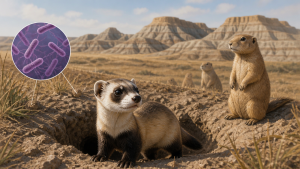
The population of the black-footed ferret (Mustela nigripes) in the Conata Basin area of South Dakota was estimated at about 70 by October 2026, down from 250 in 2024. A plague outbreak and severe drought caused a major breeding failure in 2025.
Recovery and population
After the species was declared extinct in 1980, it was rediscovered near Meeteetse, Wyoming, in 1981. Only 18 individuals remained by 1987, forming the basis of a captive-breeding programme. Reintroductions in Badlands National Park began in the mid-1990s; 147 ferrets were released in the Conata Basin from 1996 to 1999. By late fall 2023, the population there had reached 160, about half of the world’s wild population.
Plague threat and conservation
Sylvatic plague, a bacterial disease spread by fleas, affects prairie dogs, the ferret’s main food source. An outbreak reduced the local population from 355 in 2008 to 49 by 2013; another outbreak was detected in 2024. The US Forest Service and National Park Service monitor and vaccinate ferrets and apply insecticide to prairie dog colonies to control fleas. The Conata Basin, within or adjacent to Badlands National Park and Buffalo Gap National Grassland in southwestern South Dakota, is a major endangered-species recovery site.
Important Facts for Exams
- Reproduction: Black-footed ferrets have low reproductive rates; gestation lasts 42–45 days, and litters contain one to five kits.
- Plague cycle: Sylvatic plague usually circulates at predictable rates, but can become an outbreak in unexpected places at unpredictable times.
- Oral plague vaccine: Oral sylvatic-plague vaccine baits can immunise prairie dogs, complementing flea-control measures by reducing susceptibility in the ferret’s principal prey.
- Conservation cloning: The first cloned black-footed ferret, Elizabeth Ann, was born in 2020 using cells preserved from a ferret that died in 1988.
| Related | |
|---|---|