BharatGen Launches Patram 1.5 Document AI Model
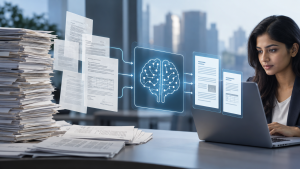
BharatGen launched Patram 1.5 on 26 November 2026. The 7-billion-parameter vision-language model is designed to read scanned, handwritten and multilingual documents, including poor-quality scans commonly encountered in India.
Document processing and language support
Patram 1.5 can process tables, signatures, stamps, photographs, charts and handwritten notes. It supports Hindi, Bengali, Tamil, Telugu, Marathi, Gujarati, Kannada, Malayalam, Punjabi and Urdu, covering more than 80% of India’s linguistic diversity. Its OCR 3.0 feature lets users request specific information in natural language and receive it as JSON, HTML or Markdown. The model can convert pages into structured text, extract fields and answer questions; its predecessor, Patram 1, answered questions about document images. It is intended to automate paperwork in banking, insurance, healthcare and government offices. When information is unclear or unreadable, it can abstain and flag the document for human review.
Evaluation and availability
Patram 1.5 scored 83 overall across 49 evaluations, matching the highest score among 21 vision-language models assessed. The tests comprised 34 public benchmarks and 15 tasks in BharatGen’s PatramBench, developed from 8,773 pages of Indian documents. The model scored 87 out of 100 on PatramBench’s abstention task. BharatGen has released its open weights on Hugging Face and made the model available through the BharatGen Playground, enabling organisations to run it on their own infrastructure. BharatGen is anchored at IIT Bombay and supported by the Department of Science & Technology and the Ministry of Electronics & Information Technology.
Important Facts for Exams
- Page layout analysis: Document OCR layout analysis groups columns, paragraphs and captions into separate blocks, a step especially important for multi-column pages and tables.
- Script identification: Multilingual OCR may need to identify script changes word by word before selecting the recognition process suited to each script.
- Handwriting recognition: Handwriting recognition is classified as ICR when it recognises handwritten printscript or cursive one character at a time, usually using machine learning.
| Related | |
|---|---|