Astronomers Find Triple-Star System with Two White Dwarfs
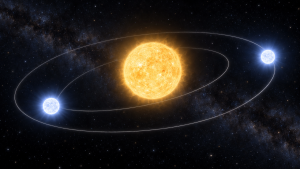
Astronomers have identified Welopōʻai, a triple-star system 28 light-years from Earth comprising a red dwarf and two white dwarfs. The findings were published in Astronomy & Astrophysics on 19 November 2026. The international team was led by the Trottier Institute for Research on Exoplanets at Université de Montréal, with Étienne Artigau as lead author.
Detection and orbital structure
The team was searching for exoplanets around the red dwarf with SPIRou, an instrument at the Canada-France-Hawaii Telescope on Maunakea, Hawaiʻi, when it detected velocity variations of nearly 16 kilometres per second. Gemini North telescope observations with its ‘Alopeke instrument, taken from December 2023 to September 2024, directly detected and confirmed the faint inner white dwarf. Welopōʻai is the closest known triple-star system containing two white dwarfs. Its inner pair—red dwarf Welopōʻai Aa and white dwarf Welopōʻai Ab—orbits every 9.83 years at about 4.64 astronomical units (AU). The second white dwarf, Welopōʻai B, orbits the pair at a projected distance of about 124 AU.
A stellar-evolution puzzle
The newly measured white dwarf has a mass of 0.618 solar masses, with an uncertainty of 0.7%; the red dwarf has a mass of 0.419 solar masses. The two white dwarfs indicate an estimated system age of 9–11 billion years, although the red dwarf is unusually metal-rich for such an ancient star. Astronomers are investigating how the red dwarf survived in a relatively wide, stable orbit after the inner white dwarf’s progenitor—about 40% more massive than the Sun—expanded into a giant. Such expansion typically tightens orbits or leads to stellar mergers. No comparable system is known within 100 light-years of Earth.
Important Facts for Exams
- Degeneracy support: A white dwarf lacks a fusion heat source; electron degeneracy pressure instead supports it against gravitational collapse.
- Stellar end state: Stars too low in mass to collapse into neutron stars or black holes are expected to become white dwarfs later in their evolution.
- Triple-system stability: Hierarchical triples are dynamically stable only when the outer orbit is sufficiently separated from the inner pair; the threshold also depends on eccentricities and component masses.
- Kozai–Lidov cycles: A distant third star can drive Kozai–Lidov cycles, exchanging inclination and eccentricity in an inner binary and potentially triggering close encounters or mergers.
| Related | |
|---|---|