Ariane 6 Deploys 36 Amazon Satellites from French Guiana
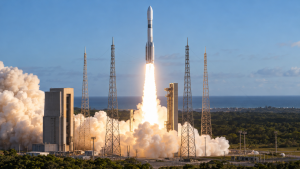
Europe’s Ariane 6 rocket launched 36 Amazon low Earth orbit (LEO) satellites from the European Spaceport at Kourou, French Guiana, on 24 November 2026. The launch took place at 8:14 a.m. local time and was designated VA271 by Arianespace and LE-04 by Amazon.
Mission and Amazon’s satellite plans
The satellites were deployed at an altitude of about 460 kilometres during a mission lasting two hours and four minutes. The flight was Ariane 6’s 10th and Arianespace’s fourth launch for Amazon’s Project Kuiper network in 2026. It had been scheduled for 23 November but was delayed by a technical issue with ground support systems. Arianespace’s 2026 deliveries for the network, also called Amazon Leo, reached 136 satellites.
Amazon aims to build a network of more than 3,200 satellites to provide high-speed internet globally and compete with services such as SpaceX’s Starlink. In September 2026, it raised its total contracted Ariane 6 missions with Arianespace to 24 by ordering six additional Ariane 64 launches.
Launch setbacks
This was Amazon’s first satellite launch since a United Launch Alliance Vulcan rocket malfunctioned on 15 November 2026 and lost its payload of 40 Amazon satellites. The Vulcan was grounded pending investigation. In June 2026, the US Federal Communications Commission granted Amazon a conditional waiver from the requirement to have half its planned satellites in orbit by July, citing a shortage of launch capacity.
Important Facts for Exams
- Stage propulsion: Ariane 6 uses liquid hydrogen and liquid oxygen: its first stage has a Vulcain engine, while its second uses the Vinci engine.
- Ariane 6 booster variants: Ariane 6 has two configurations: Ariane 62 uses two solid boosters, whereas Ariane 64 uses four, matching launcher capacity to mission requirements.
- Optical satellite links: Project Kuiper satellites use optical inter-satellite links to relay data between spacecraft, helping route traffic without every transmission passing through a ground station.
- Electronically steered terminals: Kuiper customer terminals use phased-array antennas, which steer radio beams electronically to track moving satellites without mechanically rotating the antenna.
| Related | |
|---|---|