Adani Defence Tests Bagheera AT1 Anti-Tank Missile System
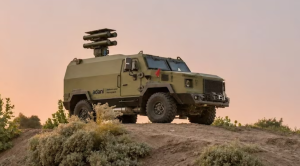
Adani Defence & Aerospace demonstrated its vehicle-mounted anti-tank guided missile (ATGM) system, Bagheera AT1, at the Pokhran Field Firing Ranges in Rajasthan on 20 November 2026. Senior representatives of the Indian Army, the Department of Military Affairs and the Ministry of Defence witnessed the trials.
Trial results and system features
Conducted under a No Cost No Commitment (NCNC) arrangement, the demonstration tested day-and-night engagements. It included a two-missile salvo against an armoured target and an engagement involving an aerial target at extended range. The salvo capability is designed to counter tanks equipped with active protection systems.
The missile’s anti-tank engagement range is up to 8 km, while its wider architecture can support guided engagements up to 10 km. It uses laser beam-riding guidance, which the company says provides high resistance to electronic jamming.
Developed over 18 months, Bagheera AT1 has been customised for Indian terrain, climate and operational requirements. The complete system combines the missile, automated launcher and day-and-night targeting systems on an Adani Defence-designed 4×4 high-mobility armoured vehicle. Each vehicle carries four ready-to-fire missiles and eight reloads. The NCNC trial allows evaluation without an upfront procurement commitment.
India’s anti-tank missile inventory
India’s inventory includes Milan-2T and Konkurs-M systems, as well as Spike missiles. The company says its programme also focuses on domestic manufacturing, maintenance and lifecycle support.
Important Facts for Exams
- Beam-riding control: In laser beam riding, the missile enters a beam aimed at the target and then uses onboard control to stay within that beam.
- Laser-warning detectability: Laser beam riding can be harder for laser warning receivers to detect than semi-active laser homing because it needs a lower-intensity signal.
- Tandem-charge warhead: The Milan-2T uses a tandem-charge warhead: a precursor charge triggers explosive reactive armour before the main shaped charge strikes.
- Active-protection countermeasures: Hard-kill active protection systems physically intercept incoming munitions, whereas soft-kill measures seek to disrupt or mislead their guidance.
| Related | |
|---|---|