Rajasthan approves NTPC’s 320-kW ceramic thermal-storage solar pilot at Bhadla
On 31 October 2026, Rajasthan Renewable Energy Corporation Limited approved NTPC’s 320-kilowatt pilot concentrated solar power project at Bhadla, Rajasthan. Described as India’s first project based on ceramic thermal storage, it will use technology developed by the American company 247Solar.
How the pilot will work
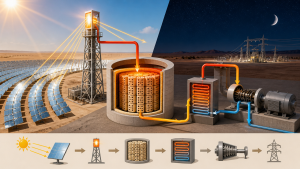
Solar energy collected during the day will be stored as heat in ceramic modules. At night, the stored heat is intended to run an air turbine and generate electricity. The pilot’s output is intended for NTPC’s own and auxiliary requirements at its plant. The stated objective is to reduce reliance on costly, heavy chemical batteries.
Following approval, preliminary feasibility work, a site survey and structural testing can proceed. The approval allows preparatory work; it does not mean the pilot is operational.
Important Facts for Exams
- Optical classification: CSP collectors use four optical layouts: parabolic trough, dish, linear Fresnel reflector and solar tower; trough and Fresnel are linear-focus, while dish and tower are point-focus.
- Storage categories: Thermal energy storage is classified as sensible-heat, latent-heat or thermochemical storage; the categories have different advantages and disadvantages that determine their applications.
- Packed-bed charging: In packed-bed thermal storage, a fluid—usually air—passes through loosely packed rock, pebbles or ceramic brick, adding heat to or extracting it from the bed.
| Related | |
|---|---|