New Catfish Species Exostoma nasibarbatum Identified in Manipur
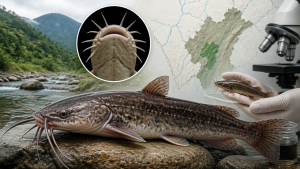
Scientists have identified a new rare glyptosternine catfish, Exostoma nasibarbatum, in Manipur. The species was found during an ichthyological survey of Bupal stream, a tributary of the Dujang River in the Chindwin river system, along the Myanmar border. The discovery was reported on 1–2 November 2026.
Species and adaptations
The research team was led by Assistant Professor Bungdon Shangningam of Dhanamanjuri University’s Department of Zoology and included PhD scholar Paya Torisha Anal. The fish is adapted to fast-flowing, turbulent streams with boulders and rocky beds. Its features include a flattened head and body, enlarged paired fins with adhesive striae, flattened maxillary barbels and elongated nasal barbels extending beyond the rear edge of the orbit. The name nasibarbatum combines the Latin words nasus (nose) and barba (beard), referring to these tactile sensory organs.
Research and publication
The species description was published in the Journal of Natural History on 1 November 2026. Shangningam, a former scientist with the Ministry of Environment, Forest and Climate Change, has identified 39 new fish species from India and Myanmar since 2012, predominantly catfishes.
Important Facts for Exams
- Maxillary barbel support: Catfish maxillae are reduced to support maxillary barbels, leaving them unable to protrude their mouths as carp do.
- Barbel chemoreception: In many larger catfish, barbels carry chemoreceptors that help detect substances by touch and chemicals in the water.
- Body covering: Catfish lack scales, but their outer covering varies between smooth skin and armour-plated bodies.
| Related | |
|---|---|