Navy, Coast Guard Plan 76 Utility Helicopters
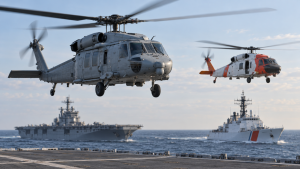
As of November 23–24, 2026, the Indian Navy and Indian Coast Guard are planning to acquire 76 utility helicopters in a deal estimated at Rs 15,000 crore (about $1.62 billion). The proposed fleet would replace their ageing Cheetah and Chetak helicopters.
Proposed procurement and contenders
The Indian Navy is expected to receive 51 helicopters and the Coast Guard 25. The aircraft, in the 5-tonne-plus class, are proposed for domestic manufacture by Indian companies in partnership with foreign original equipment manufacturers under the ‘Buy and Make (Indian)’ category of the Defence Acquisition Procedure. The proposal is expected to be considered at a high-level Ministry of Defence meeting. Potential contenders include Leonardo’s AW169M, Airbus Helicopters’ H160M and Hindustan Aeronautics Limited’s Utility Helicopter-Maritime (UH-M). Leonardo partnered with Adani Defence and Aerospace in February 2026 to manufacture in India. Some candidate models may exceed the 5.5-tonne limit specified in an August 2025 Request for Information.
Earlier and parallel helicopter plans
A 2018 Indian Navy plan to procure 111 naval light utility helicopters made little progress. Separately, the Navy is pursuing 60 Utility Helicopter-Maritime helicopters from Hindustan Aeronautics Limited, which is developing the aircraft indigenously.
Important Facts for Exams
- Cheetah airframe: The Cheetah combines the lighter Alouette II airframe with Alouette III components and powerplant, reflecting its hybrid design lineage.
- Chetak production: HAL’s Chetak was a licence-built Alouette III, produced at the company’s Indian facilities under an agreement with Aérospatiale.
- Variable-speed rotor: The AW169 uses twin FADEC turboshaft engines and varies main-rotor speed to reduce external noise and improve efficiency.
- Transmission clutch: The AW169 has no auxiliary power unit; its transmission clutch can stop the rotors while an engine continues powering onboard systems.
| Related | |
|---|---|