NASA’s Swift Observatory Re-enters Earth’s Atmosphere
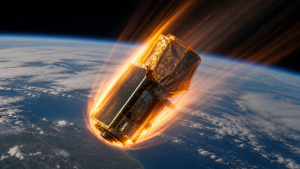
NASA’s 22-year-old Neil Gehrels Swift Observatory re-entered Earth’s atmosphere on Wednesday, 4 November 2026. The U.S. Space Force confirmed its re-entry at 7:39 a.m. EST (12:39 GMT) over North Sumatra province, Indonesia. The 1,452-kilogram spacecraft was travelling at about 22 times the speed of sound.
Failed rescue and re-entry
NASA assessed the risk of harm to anyone on Earth from falling debris at about 1 in 2,100. Most of the observatory was expected to burn up from atmospheric friction, although fragments may have survived. No injuries or damage were reported.
A rescue mission launched in July 2026 with Arizona-based start-up Katalyst aimed to use its LINK spacecraft to attach to Swift and raise its orbit. LINK spun uncontrollably after reaching space, and the attempt was abandoned; LINK itself re-entered the atmosphere in September. Swift stopped operating on 20 October after months of declining orbital stability.
Swift’s scientific mission
Launched in November 2004 for a planned two-year mission, Swift operated for 22 years. It studied gamma-ray bursts, supernovae, black holes, X-ray flares, asteroids and comets, contributing to about 7,000 scientific research papers.
Important Facts for Exams
- Multi-band payload: Swift’s three instruments jointly observe gamma-ray bursts and their afterglows across gamma-ray, X-ray, ultraviolet and optical wavebands.
- Autonomous repointing: Swift uses momentum wheels and monitor scans to autonomously slew towards possible gamma-ray bursts.
- Burst Alert Telescope: Swift’s Burst Alert Telescope uses a coded-aperture mask of lead tiles above a cadmium zinc telluride hard X-ray detector plane.
- X-ray optics: Swift’s X-ray Telescope uses 12 nested Wolter Type I mirrors to focus X-rays onto a single MOS charge-coupled device.
| Related | |
|---|---|