NASA’s SpaceX Crew-12 Returns After 237-Day Mission
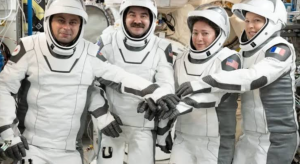
NASA’s SpaceX Crew-12 astronauts returned to Earth on 8 October 2026 after 237 days aboard the International Space Station (ISS). Their SpaceX Crew Dragon Freedom spacecraft splashed down in the Pacific Ocean off Los Angeles at 8:34 a.m. Pacific Daylight Time. The crew completed more than 3,792 Earth orbits and travelled over 100 million miles.
Crew and Mission Profile
The crew comprised NASA astronauts Jessica Meir and Jack Hathaway, European Space Agency (ESA) astronaut Sophie Adenot, and Roscosmos cosmonaut Andrey Fedyaev. Crew-12 launched on 13 February 2026 and docked with the ISS the following day. Meir and Fedyaev had previously travelled to space, while Hathaway and Adenot completed their first space missions.
The ISS is a permanently crewed research laboratory in low Earth orbit, where astronauts conduct experiments in microgravity. After splashdown, SpaceX recovery teams retrieved the capsule and crew. The astronauts underwent medical evaluations before travelling to NASA’s Johnson Space Center in Houston.
Scientific Investigations in Microgravity
Crew-12 conducted research related to human health and future space exploration. Investigations included producing stem cells in space, developing technology to make intravenous fluids on demand, and examining how pneumonia-causing bacteria may contribute to heart damage. Other studies examined nutrition and factors affecting blood flow during spaceflight.
On-demand IV fluid production could support crews on long-duration missions far from Earth, where resupply is limited. Research into health effects in microgravity can inform medical planning for extended human spaceflight. The mission’s investigations included work relevant to planned crewed exploration of the Moon and Mars.
Extravehicular Activity
A spacewalk, formally called extravehicular activity (EVA), is work performed by an astronaut outside a spacecraft or space station while wearing a spacesuit. Meir completed four spacewalks during Crew-12, bringing her career total to seven. She ranked third among NASA women for career spacewalks, after Peggy Whitson and Suni Williams. Adenot completed three spacewalks and became the first French woman to conduct a spacewalk outside the ISS.
Important Facts for Exams
- The International Space Station operates in low Earth orbit.
- Microgravity research allows scientists to study biological and physical processes in conditions different from those on Earth.
- Extravehicular activity is the formal term for work conducted outside a spacecraft or space station.
- The European Space Agency is an intergovernmental organisation dedicated to space activities.
Crew-12’s mission lasted 237 days, and its crew completed more than 3,792 orbits of Earth. NASA’s Johnson Space Center is located in Houston, Texas.
| Related | |
|---|---|