Leucistic Great Cormorant Spotted at Ameenpur Lake
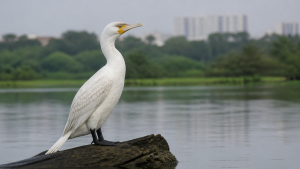
A rare leucistic Great Cormorant was spotted at Ameenpur Lake near BHEL in Hyderabad on 19 September 2026. The bird had unusually pale feathers, while the Great Cormorants around it showed the species’ usual dark plumage. The sighting was documented with photographs by Raghuvamsh Chavali, a Hyderabad-born Canadian birder.
Great Cormorant
The Great Cormorant is a large waterbird belonging to the family Phalacrocoracidae. It is a fish-eating bird that is commonly seen near lakes, wetlands, rivers, estuaries, and coastal waters. The species is known for its dark plumage, long neck, hooked bill, and strong diving ability.
Leucism in Birds
Leucism is a pigmentation condition in birds that causes reduced colour in feathers, skin, or scales. It can make a bird appear partly or fully white, but it does not affect the eye colour in the same way as albinism. Albinism is a separate genetic condition linked to the absence of melanin.
Ameenpur Lake
Ameenpur Lake is a freshwater lake in Telangana and is located near the BHEL area of Hyderabad. It is known as a birding site in the Hyderabad region and attracts birdwatchers because of its wetland habitat. Wetlands such as lakes and marshes support resident and migratory bird species.
Important Facts for Exams
- The Great Cormorant belongs to the family Phalacrocoracidae.
- Leucism causes reduced pigmentation and is different from albinism.
- Cormorants are diving birds that feed mainly on fish.
- Ameenpur Lake is a freshwater wetland in Telangana.
Birdwatching is the observation of birds in their natural habitats and is a common activity in wetlands and protected areas. Hyderabad has several urban and peri-urban water bodies that support bird diversity.
| Related | |
|---|---|