Key Concepts in Collective Security and Mutual Defence
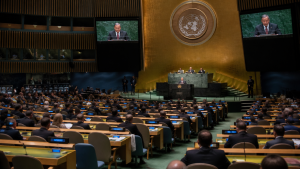
Collective security and mutual defence are two distinct security arrangements used by states to prevent war and respond to attacks. While collective security is broad and universal, mutual defence is limited to specific allies who promise to defend one another.
Understanding Collective Security
Collective security is an international security arrangement in which a group of states agrees to a common security pact. The core principle is that an attack on one member is treated as an attack on all members. It usually operates through a broad global organisation to preserve peace within the system.
Core Instruments under the United Nations Charter
- Article 2(4): Prohibits the threat or use of force against the territorial integrity or political independence of any state.
- Article 39: Empowers the UN Security Council to determine the existence of any threat to the peace, breach of the peace, or act of aggression.
- Article 41: Allows non-military measures such as economic sanctions, embargoes, and severance of diplomatic relations.
- Article 42: Authorises military action by air, sea, or land forces if peaceful measures are inadequate.
- Article 51: Recognises the inherent right of individual or collective self-defence if an armed attack occurs against a member state.
Understanding Mutual Defence
Mutual defence, also known as collective defence, is a security alliance in which a specific group of states agrees to defend one another against external threats. Unlike collective security, which focuses on maintaining peace within a wider system, mutual defence is outward-looking and aims to deter outside adversaries. Such agreements are generally regional or bilateral.
Prominent Mutual Defence Treaties
- The North Atlantic Treaty (1949): Established NATO, binding North American and European nations to mutual defence.
- The Warsaw Pact (1955): A collective defence treaty signed by the Soviet Union and seven Eastern Bloc states during the Cold War; it dissolved in 1991.
- The ANZUS Treaty (1951): A security treaty binding Australia, New Zealand, and the United States to cooperate on military matters in the Pacific region.
- The Inter-American Treaty of Reciprocal Assistance (Rio Treaty) (1947): Established a mutual defence system among American republics.
- Bilateral Mutual Defence Treaties: The United States maintains bilateral mutual defence treaties with several nations, including Japan (1960) and South Korea (1953).
Comparing Collective Security and Mutual Defence
| Feature | Collective Security | Mutual Defence |
| Scope | Global or universal membership. | Regional, restricted, or bilateral membership. |
| Primary Target | Internal aggressors, including any member state that breaks the peace. | External aggressors, non-member states, or specific rivals. |
| Primary Focus | Maintaining global order and preventing conflict among members. | Deterring external attacks and defending member borders. |
| Key Example | The United Nations and the League of Nations. | NATO and the Warsaw Pact. |
| Legal Basis | Global treaty and international law, such as the UN Charter Chapter VII. | Regional pacts aligned with self-defence provisions, such as UN Charter Article 51. |
| Action Initiation | Decided by a central governing body like the UN Security Council. | Triggered automatically or jointly by an attack on a member state. |
Key Treaty Provisions and Activation Clauses
- NATO Article 5: An armed attack against one member in Europe or North America is considered an attack against them all. Each member must assist the attacked party by taking such action as it deems necessary, including the use of armed force.
- League of Nations Article 16: Mandated immediate economic and military sanctions against any member state that resorted to war in disregard of its covenants.
- Rio Treaty Article 3: Stipulates that an armed attack by any state against an American state shall be considered an attack against all American states.
Historical Case Studies
- The League of Nations Failures (1930s): The League failed to enforce collective security during the Japanese invasion of Manchuria in 1931 and the Italian invasion of Abyssinia in 1935. Member states preferred national interests over collective action.
- The Korean War (1950): The first major collective security action under the UN. The Security Council authorised military assistance to South Korea because the Soviet Union was boycotting the Council and could not veto the action.
- The Gulf War (1990-1991): The UN Security Council passed Resolution 678, authorising member states to use all necessary means to expel Iraqi forces from Kuwait. This is a classic example of collective security in action.
- September 11 Attacks (2001): NATO activated Article 5 for the first and only time in its history after the terrorist attacks on the United States. This led to joint naval patrols in the Mediterranean and airspace monitoring.
Contemporary Challenges and Evolutions
- Security Council Veto Power: The veto power of the five permanent members of the UN Security Council often paralyses collective security action, especially when a permanent member is directly involved.
- Asymmetric Warfare: The rise of non-state actors, terrorism, and proxy wars makes it difficult to define an armed attack under mutual defence treaties.
- Cyber Warfare: Modern treaties struggle to determine whether cyberattacks on critical infrastructure qualify as armed attacks triggering a mutual defence response.
- Rise of Minilateralism: States increasingly form smaller, flexible security partnerships such as the Quad and AUKUS to address regional security issues without formal mutual defence obligations.
Treaty interpretation: Security pacts often depend on how clearly an “armed attack” is defined.
Deterrence strategy: Mutual defence is mainly designed to deter enemies by making retaliation automatic or highly likely.
Conflict escalation: Collective commitments can widen a local attack into a broader international crisis if not carefully managed.
Rare Facts for Prelims
- UN Charter Chapter VII: It is the main legal basis for enforcement action by the Security Council.
- NATO Article 5: It does not automatically require military action; each member decides the assistance it deems necessary.
- The League of Nations: It had a collective security framework but lacked strong enforcement power.
- ANZUS: New Zealand’s nuclear-free policy later affected its full defence posture within the alliance.
- Rio Treaty: It is also called the Inter-American Treaty of Reciprocal Assistance and was signed in 1947.
- Security alliances: Not all defence pacts are military-only; many also include political coordination and technology sharing.
Recent Context
The Mecca Joint Defence Agreement is a trilateral mutual defence pact signed on August 7, 2026, by Turkey, Saudi Arabia, and Pakistan. It includes a collective security clause, a joint strategic committee, and cooperation in defence production and technology sharing.
| Related | |
|---|---|