JNCASR Develops Silicon Chip for Terahertz 6G Communication
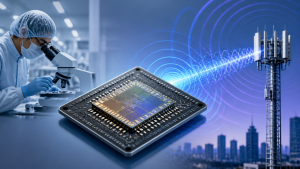
On 4 November 2026, researchers at the Jawaharlal Nehru Centre for Advanced Scientific Research (JNCASR) developed a silicon chip that lets terahertz waves pass through engineered barriers with minimal signal loss. It achieved data transmission at 100 Gbit/s for compact circuits designed for future 6G networks. The research was published in Advanced Materials.
Chip targets terahertz signal loss
Terahertz frequencies span 0.1–10 THz and offer wide bandwidth, but high signal loss complicates device development. The JNCASR team plans to tune the chip’s barriers electrically, thermally or mechanically, allowing devices to redirect signals between paths on demand.
Related silicon-chip research
In 2024, a University of Adelaide team led by Withawat Withayachumnankul, including Weijie Gao, now at Osaka University, developed an ultra-wideband integrated terahertz polarisation (de)multiplexer on a substrateless silicon base. Tested in the 220–330 GHz J-band, it carries multiple data streams in the same frequency band, effectively doubling capacity; the team anticipated commercial prototypes and products within a decade. In December 2023, Nanyang Technological University researchers led by Ranjan Singh developed two chips to address signal scattering and interference. One transmitted up to 160 Gbit/s and could be switched using light. The other isolated two channels, supporting real-time high-definition video at 1.5 Gbit/s on one channel and data transmission at 40 Gbit/s on the other.
Important Facts for Exams
- Frequency band: Terahertz radiation spans 0.1–10 THz, occupying the transition region between microwave and far-infrared radiation.
- Atmospheric attenuation: Atmospheric gases strongly absorb terahertz waves, attenuating most energy within a few metres and limiting their use for long-distance terrestrial radio links.
- 6G spectrum status: 6G frequency bands remain undecided, although 100 GHz–3 THz has been identified as promising because it offers wide swathes of unused spectrum.
| Related | |
|---|---|