India’s Auto-Component Trade Deficit Reaches $1.4 Billion
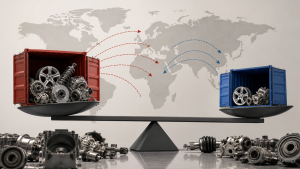
India’s auto-component trade balance turned into a 1.4-billion deficit in FY2025–26, with exports of about 24 billion and imports of $25.4 billion. The gap was discussed at the 66th Annual Session of the Automotive Component Manufacturers Association of India in New Delhi on 2 September 2026.
Auto-Component Trade Structure
India’s auto-component exports remain concentrated in mature technologies, which include established parts and assemblies used in conventional vehicle manufacturing. Imports are led by advanced, high-value components such as semiconductors, electric vehicle battery cells, and power electronics.
Auto components are parts and systems used in passenger vehicles, commercial vehicles, two-wheelers, and electric vehicles. The sector includes engines, transmissions, braking systems, electronics, batteries, and software-linked modules.
Industrial Policy and Technology Shift
Hyundai Motor India MD and CEO Tarun Garg called for a shift from “Make in India” to “Design, Engineer, and Create in India”. The phrase refers to domestic ownership of product design, engineering, and research and development in addition to manufacturing.
Union Minister for Heavy Industries and Steel H.D. Kumaraswamy asked the industry to invest in clean, efficient, and emerging technologies. Commerce and Industry Minister Piyush Goyal asked manufacturers to use market access created through recent trade agreements for overseas production footprints.
Production Linked Incentive Scheme and Industry Targets
The Production Linked Incentive Scheme for Automobile and Auto Components had generated ₹45,477 crore in approved investments and more than 67,000 jobs by 30 June 2026. The scheme is a central government incentive framework linked to incremental production and investment in specified sectors.
A joint report by Boston Consulting Group and the Automotive Component Manufacturers Association of India projected a $200 billion turnover target for the industry by FY30. The same industry discussion noted risks from labour shortages and volatile material costs.
Important Facts for Exams
- The Automotive Component Manufacturers Association of India is the apex industry body for auto-component manufacturers in India.
- Electric vehicles use battery cells, power electronics, and control systems that have higher import dependence than many conventional vehicle parts.
- Software-defined vehicles are vehicles in which software controls major functions such as infotainment, connectivity, and driving features.
- The Production Linked Incentive Scheme is used in India to support manufacturing output and investment in selected sectors.
Trade Balance and Sector Outlook
ACMA data released on 8 July 2026 showed that the deficit followed two years of surplus. The reversal was linked to rising domestic sales of electric vehicles and software-defined vehicles, which require imported components.
| Related | |
|---|---|