IIT (ISM) Dhanbad Team Develops Catalyst for Green Hydrogen Production
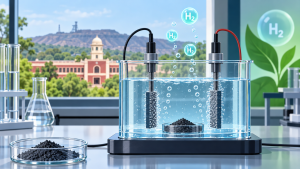
Researchers at IIT (ISM) Dhanbad have developed an electrode material for producing hydrogen through water splitting. The work combines molybdenum disulphide and vanadium sulphide with reduced graphene oxide. It uses molybdenum, vanadium, sulphur and carbon rather than relying on costly noble-metal catalysts.
Research team and publication
The study was carried out in the institute’s Physics Department by Rumana Sultana Parvin, Priyadarshani Tamang and Sk Riyajuddin. It was first published online in the journal Small on 17 January 2026 and received news coverage in February.
How the material works
The combined structure supports the hydrogen- and oxygen-producing reactions involved in splitting water. Reduced graphene oxide helps charges move between the two sulphide components. Laboratory tests demonstrated overall water splitting at a cell voltage of 1.55 V and a current density of 10 milliamperes per square centimetre, with stability tested over 20 hours.
Solar-powered demonstration
The researchers also connected the system to a silicon solar cell to demonstrate solar-to-hydrogen conversion. The findings concern laboratory performance; commercial-scale production and a market price for hydrogen were not established by these tests.
| Related | |
|---|---|