Government Outlines Roadmap for Self-Reliant Nuclear Energy Ecosystem
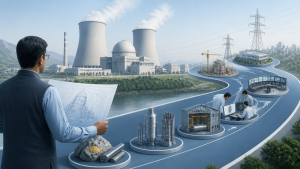
India has set a target of 100 GWe of nuclear energy capacity by 2047 under the Nuclear Energy Mission. The roadmap combines large indigenous Pressurised Heavy Water Reactors at greenfield sites with Small Modular Reactors at brownfield sites, including locations of retiring fossil-fuel plants.
Nuclear Energy Mission and Capacity Targets
The Nuclear Energy Mission is linked to a capacity target of 100 GWe by 2047. The government has also set a target to develop and operationalise at least five indigenously designed Small Modular Reactors by 2033 with support from a ₹20,000 crore allocation.
Pressurised Heavy Water Reactors are a reactor type in which heavy water acts as both moderator and coolant. Small Modular Reactors are compact nuclear reactors designed for factory-based construction, modular deployment, and phased capacity addition.
Indigenous Reactor Designs
The Bhabha Atomic Research Centre is developing several domestic reactor designs for the programme. These include the 220 MWe Bharat Small Modular Reactor, the 55 MWe SMR-55, and a High Temperature Gas Cooled Reactor of up to 5 MWth for hydrogen production.
High Temperature Gas Cooled Reactors use helium or another inert gas as coolant and operate at high temperatures. Hydrogen production through nuclear heat is a recognised industrial application of high-temperature reactor systems.
Legal Framework and Industrial Participation
The Sustainable Harnessing and Advancement of Nuclear Energy for Transforming India Act, passed in December 2025, provides the legal basis for the roadmap. The Act ended the state monopoly in the sector and permits domestic private participation and up to 49% foreign direct investment.
Bhabha Atomic Research Centre is also transferring technology and sharing knowledge with Indian industries for local manufacturing of Small Modular Reactor components. NITI Aayog held a stakeholder consultation in July 2026 to discuss draft rules, regulatory frameworks, and domestic supply chain requirements for the Act.
Important Facts for Exams
- Pressurised Heavy Water Reactors are a major reactor type used in India’s indigenous nuclear programme.
- Small Modular Reactors are designed for smaller capacity blocks and modular construction.
- The Bhabha Atomic Research Centre is India’s premier nuclear research institution.
- The Supreme Court of India heard a petition on the liability cap and safety provisions of the SHANTI Act in February 2026.
Regulatory and Judicial Context
The SHANTI Act includes a liability cap of approximately ₹3,900 crore. A petition before the Supreme Court of India challenged this provision and raised questions on safety and accountability.
| Related | |
|---|---|