Dehradun scientists report Bodh Gaya’s Bodhi tree is in good health
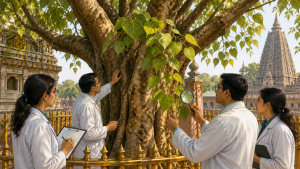
Scientists from the Forest Research Institute (FRI), Dehradun, assessed the Bodhi tree at Mahabodhi Mahavihara in Bodh Gaya, Bihar, on 2 November 2026. Dr Santan Barthwal said the tree was in very good health, with no signs of infection or disease on its leaves.
Assessment and recommended care
The team found no insects damaging the leaves. It recommended minor maintenance, including pruning dry branches under scientific supervision and applying an organic pesticide spray. The FRI and the Bodhgaya Temple Management Committee (BTMC) collaborate on regular scientific monitoring and long-term conservation of the tree. The assessment team visits every 60 days under this arrangement.
Important Facts for Exams
- Leaf symbolism: Ficus religiosa’s heart-shaped leaves are commonly depicted in Buddhist art and have come to symbolise wisdom and spiritual awakening.
- Present tree’s origin: The present Bodh Gaya tree was planted in 1881 by Alexander Cunningham using a cutting from the Sri Lankan tree.
- Sri Lankan descendant: The Jaya Sri Maha Bodhi at Anuradhapura descends from a sapling sent from Bodh Gaya by Ashoka’s daughter Sanghamittā in 288 BCE.
Originally written on
November 3, 2026
and last modified on
November 3, 2026.
| Related | |
|---|---|