Aditya-L1 Detects Asymmetric Expansion of Solar Eruption
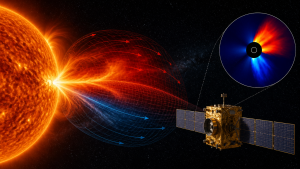
Scientists at the Indian Institute of Astrophysics (IIA), Bengaluru, published a study in The Astrophysical Journal Letters on 3 November 2026 describing the asymmetric expansion of a solar eruption observed on 5 August 2024. The study combined observations from Aditya-L1’s Visible Emission Line Coronagraph (VELC), NASA’s Solar Dynamics Observatory (SDO) and three-dimensional modelling.
VELC measurements of the August 2024 eruption
The analysis found that the Coronal Mass Ejection (CME) expanded unevenly rather than as a symmetric bubble. VELC measured line-of-sight plasma velocities of up to 218 km/s, a projected radial speed of 1,135 km/s and a plane-of-sky lateral speed of 692 km/s. Its spectroscopy of the Fe XIV 5303 Å green coronal line helps track plasma motion in the low corona. Differences in CME expansion can affect its speed and trajectory towards Earth. On 21 October 2026, VELC Doppler velocity images were also reported as providing information on plasma motion and whether CMEs are Earth-directed.
Other VELC and joint coronagraph observations
A study published in Astronomy & Astrophysics on 15 October 2026 presented the first joint analysis of solar eruptions by Aditya-L1/VELC and Europe’s Proba-3/ASPIICS, examining CMEs observed on 14 and 16 September 2025. The first travelled at about 645 km/s; the second travelled at 145 km/s and showed stronger early expansion. VELC also observed a CME on 16 July 2024 associated with an X1.9-class solar flare. It showed coronal dimming and a redshifted Doppler velocity of about +10 km/s, indicating plasma moving away from the observer.
Important Facts for Exams
- Occulting spot: A solar coronagraph places an opaque spot at an intermediate focal plane and re-images the field to reveal the faint corona beside the bright solar disc.
- Aditya-L1 orbit: Aditya-L1 operates in a halo orbit around the Sun–Earth L1 region; it is not stationary at the gravitational balance point.
- VELC field of view: VELC observes the inner corona from roughly 1.05 to 3 solar radii, a region important for tracking CME initiation and early acceleration.
- SDO orbit: SDO’s geosynchronous orbit provides near-continuous solar observations, although seasonal eclipses interrupt viewing for short periods.
| Related | |
|---|---|