Tamil Nadu Plans Conservation Action for Threatened Species
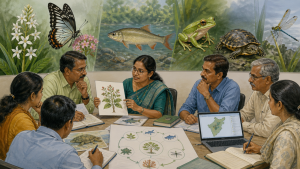
The Tamil Nadu Biodiversity Board (TNBB) held a two-day workshop in Chennai on October 30, 2026, to develop an action plan for endangered and critically endangered species in the State. Minister for Forests and TNBB chairperson R.V. Ranjith Kumar inaugurated the workshop, held on the occasion of World Sustainability Day.
Species recovery proposals
At the workshop, titled ‘Species on the Brink – Towards a Meaningful Strategy and Action Plan for Conservation’, researchers and experts from scientific and research institutions discussed threats, mitigation measures and conservation priorities. Separate groups considered angiosperms, other plant groups, invertebrates, reptiles and amphibians, freshwater fish and marine biodiversity.
The groups developed a template for further action and proposed species-specific recovery plans and mission-mode conservation efforts. Suggestions included a dedicated threatened plant recovery fund; in-situ and ex-situ conservation centres; protection of habitats and micro-niches; and monitoring amphibian breeding sites. Participants also discussed sustainable use of tradable species.
Biological Diversity Act outreach
Ranjith Kumar released a handbook on the Biological Diversity Act for Biodiversity Management Committees and a Tamil-language film about the Act to raise public awareness. TNBB Member Secretary Mita Banerjee said the workshop groups had proposed strategies for conserving Tamil Nadu’s endangered and critically endangered flora and fauna.
Important Facts for Exams
- Permission for biological resources: Under the Biological Diversity Act, foreign entities and non-resident Indians require National Biodiversity Authority permission; Indian citizens and companies seek permission from the relevant State Biodiversity Board.
- Benefit-sharing options: The Act’s benefit-sharing measures can include technology transfer, locating production or research units near the resource source, and monetary or non-monetary compensation.
- Evolution in natural habitats: A benefit of in-situ conservation is that it maintains the processes of evolution and adaptation within species’ environments.
- Research-result transfer: Research results using Indian biological resources cannot be transferred to non-citizens or foreign companies without National Biodiversity Authority permission, with exceptions for publication and approved collaborative research.
| Related | |
|---|---|