Critically examine how Extended Producer Responsibility (EPR) mechanisms address plastic waste management in India. Why have technological and supply-chain bottlenecks limited its overall efficacy?
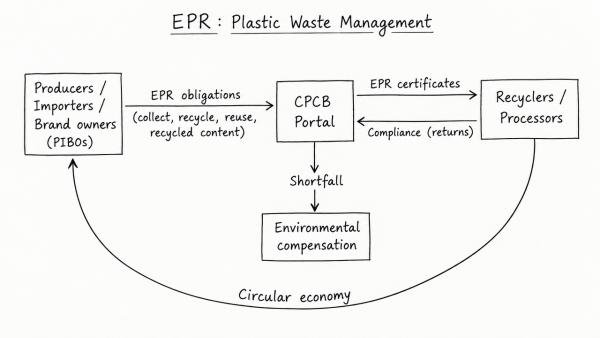
India’s Extended Producer Responsibility (EPR) framework makes producers, importers and brand owners (PIBOs) responsible for plastic packaging after sale. Under the Plastic Waste Management Rules, 2016, and subsequent amendments, it seeks to shift costs from municipalities to businesses and promote circularity. How it works PIBOs must meet collection, recycling, reuse and recycled-content obligations across four packaging categories. The CPCB’s digital portal registers businesses and processors, records returns and enables trading of EPR certificates; environmental compensation applies to shortfalls. Rising category-wise targets, reuse requirements and restrictions on selected single-use plastics create incentives for redesign and investment. Certificates can mobilise private finance and help channel waste to authorised recyclers, including where firms lack direct collection networks. Critical limits Yet compliance can become transactional: buying certificates may prove paperwork, not additional recovery, unless quantities and end use are independently audited. Weak source segregation contaminates feedstock, while uneven collection and sorting infrastructure—especially outside cities—raises costs and reduces quality. Informal waste pickers perform much first-mile recovery but remain poorly integrated, protected and remunerated. Flexible and multilayered packaging is difficult to sort and recycle: inks, adhesives and mixed materials hinder recovery, while low-value waste often costs more to collect than credits cover. Advanced sorting and recycling capacity is limited; co-processing or disposal may therefore substitute for material recycling. Fragmented state enforcement, inconsistent verification, certificate price volatility and possible over-issuance further weaken trust. Recycled-content mandates also depend on reliable, safe, high-quality recyclate, which contaminated supply cannot provide. Thus, EPR is necessary, but insufficient.