Critically discuss how a standardized drug registry can curb out-of-pocket healthcare expenditure in India. Why does the transition from branded to generic medicines face systemic resistance?
India’s out-of-pocket health spending remains high, with medicines forming the largest share of household burden. A standardised drug registry under ABDM can reduce this burden by making medicine names, strengths, prices and equivalents easy to identify and compare.
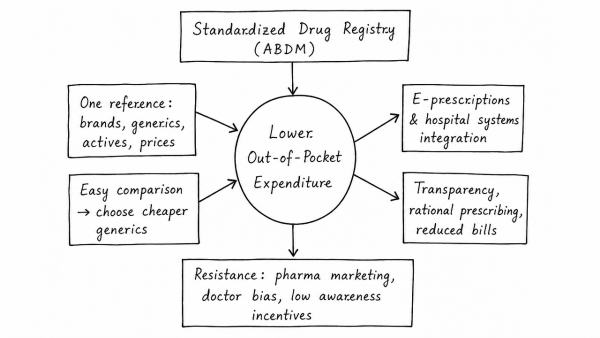
- How it can cut expenditure
- It creates a single digital reference for branded drugs, generics and active substances, reducing confusion caused by multiple names for the same medicine.
- Doctors, pharmacists and patients can compare brand and generic options quickly, improving price transparency and promoting cheaper substitutes.
- Integration with e-prescriptions and hospital systems can support generic prescribing and reduce avoidable repeat visits caused by prescription errors.
- Standardised naming can also reduce duplication, wrong dispensing and adverse drug events, which often lead to extra tests, longer treatment and higher costs.
- Critical limits
- A registry improves information, but it does not by itself ensure lower prices, better quality, or steady supply.
- Its impact will be weak if public procurement, pharmacy stocking and prescriber behaviour do not change.
- Without stronger quality assurance and enforcement, patient trust in generics may remain low.
- Why branded-to-generic shift faces resistance
- Doctors often trust known brands because of habit, perceived predictability and fear of therapeutic variation.
- Pharmaceutical marketing and branded-generic business models create strong financial incentives to retain brand preference.
- Patients link brands with safety and efficacy, while many generics are seen as inferior.
- Weak enforcement, uneven quality control, and irregular availability of generic medicines deepen this resistance.
Thus, a standardised drug registry is a useful enabling reform, but it must be backed by quality regulation, reliable supply chains, generic substitution rules and public awareness to meaningfully reduce out-of-pocket spending.
Originally written on
June 18, 2026
and last modified on
September 16, 2026.