Analyse how Mongolia’s ‘Third Neighbor’ foreign policy seeks to balance its geopolitical dependency on China and Russia. How can India strengthen this strategic partnership?
Mongolia’s Third Neighbor policy is a deliberate effort to prevent over-dependence on China and Russia, its two immediate and powerful neighbours. By widening external ties, Ulaanbaatar seeks to protect sovereignty, improve bargaining power and preserve policy autonomy in a difficult neighbourhood.
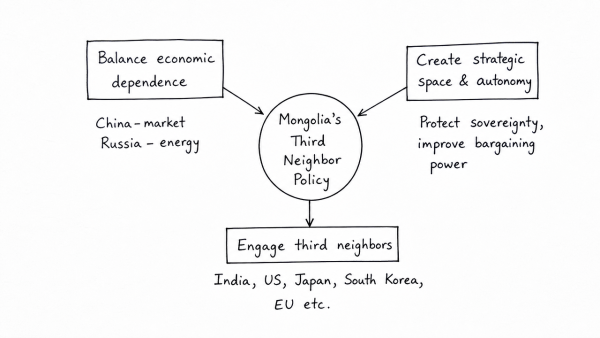
- Balancing economic dependence: China buys most of Mongolia’s exports, especially minerals, while Russia supplies much of its fuel and energy. Third-neighbour ties help Mongolia diversify markets, investment and technology, reducing vulnerability to pressure from either side.
- Strategic space: Partnerships with India, the US, Japan, South Korea and the EU give Mongolia diplomatic room to act independently. This is important for a landlocked state that must avoid being trapped in a binary China-Russia framework.
- Security and norms: Engagement with democratic partners, peacekeeping, and multilateral forums helps Mongolia strengthen its institutions and maintain a neutral, peaceful image.
- How India can deepen the partnership:
- Speed up the oil refinery project and related energy cooperation to cut Mongolia’s fuel dependence on Russia.
- Expand trade, mining, critical minerals, renewable energy and digital cooperation, with easier business links and logistics support.
- Increase defence training, peacekeeping exercises and border management cooperation to build capacity.
- Broaden scholarships, ITEC slots, language training and healthcare cooperation to deepen human capital links.
- Strengthen Buddhist and civilisational ties through monasteries, cultural exchanges and tourism promotion.
Thus, Mongolia’s policy is not anti-neighbour, but pro-autonomy. India, as a trusted democratic and civilisational partner, can become a stable third neighbour by combining energy security, capacity building and long-term people-to-people engagement.
Originally written on
May 20, 2026
and last modified on
September 11, 2026.