Lucknow University receives Indian patent for research on bismuth-based anticancer compounds
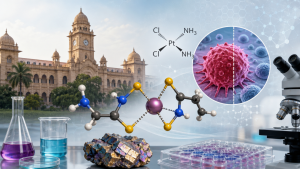
Lucknow University has received an Indian patent for research led by Professor Om Prakash on preparing bismuth dithiocarbamate complexes and studying their potential against cancer.
Research on bismuth complexes
The researchers combined bismuth with a chemical substance to prepare new compounds. In the reported research, using these complexes instead of cisplatin was associated with lower toxicity and fewer deaths among healthy cells. The findings concern the described research; a patent grant does not itself establish clinical efficacy or approval as a medicine.
Important Facts for Exams
- Ligand coordination: Dithiocarbamate ligands tend to bind as bidentate donors, linked to nitrogen π-donation and their greater basicity than related dithiocarboxylates and xanthates.
- Oxidation states: Bismuth is in the +3 oxidation state in almost all known compounds; +5 and −3 states occur in only a few.
- Cisplatin geometry: Cisplatin is a square-planar platinum(II) complex; its cis geometry allows adjacent leaving groups to form DNA cross-links, unlike transplatin.
- Bismuth in H. pylori therapy: Bismuth-based quadruple therapy for Helicobacter pylori pairs a bismuth salt with a proton-pump inhibitor, tetracycline and metronidazole.
Originally written on
November 2, 2026
and last modified on
November 2, 2026.
| Related | |
|---|---|