Hollongapar Gibbon Uses Artificial Canopy Bridge Above Railway
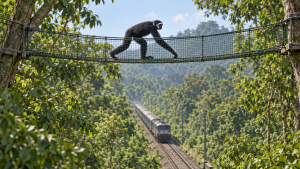
A male western hoolock gibbon was recorded using an artificial canopy bridge above the railway line in Assam’s Hollongapar Gibbon Sanctuary. The crossing was publicly reported on 15 May 2026, showing use of a structure designed to reconnect habitat divided by the tracks.
Crossing above the tracks
The bridge includes safety nets and provides an overhead route for tree-dwelling animals. It was developed through cooperation between the Wildlife Institute of India, the Assam Forest Department and Northeast Frontier Railway. The recorded use follows the installation of the structure in the previous year.
Habitat fragmentation in Jorhat
Hollongapar is a small protected forest in Jorhat district, covering about 21 square kilometres. The railway line through the sanctuary separates sections of forest canopy. Western hoolock gibbons are strongly dependent on trees for movement, making canopy breaks a conservation concern.
Conservation purpose
Artificial bridges offer a route between separated trees without requiring animals to descend to the ground or cross at track level. Monitoring their use helps assess whether a wildlife-crossing design is serving its intended species.
| Related | |
|---|---|