Bandhavgarh gaur population estimated at 220 to 240 after restoration efforts
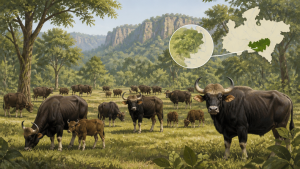
The gaur population in Bandhavgarh Tiger Reserve, Madhya Pradesh, is estimated at 220–240, with animals also recorded in forests around the Umaria Forest Division. Gaur had become locally extinct in Bandhavgarh by 1998.
Gaur restoration in Bandhavgarh
The restoration programme began in 2011–12 with the transfer of about 50 gaur from Kanha Tiger Reserve. The animals adapted and bred in the reserve, and the population reached about 170.
With support from the Wildlife Institute of India, the Madhya Pradesh Forest Department transferred a further 50 gaur from Satpura Tiger Reserve: 23 in February 2025 and 27 in January 2026. The programme aimed to increase genetic diversity and support a more stable population.
Important Facts for Exams
- Population restoration: Conservation translocation classifies population restoration as either reinforcing an existing population or reintroducing a species where it has disappeared.
- Reinforcement planning: Reinforcement planning considers whether habitat can sustain the population and whether incoming animals bring diverse genetics from a similar ecological area.
- Gaur–mithun taxonomy: Gaur is the wild species Bos gaurus; mithun, also called gayal, is often classified as Bos frontalis, although its relationship to gaur remains taxonomically debated.
- Herd structure: Gaur typically live in female-led herds, while adult bulls are often solitary or form small bachelor groups outside the breeding season.
Originally written on
November 4, 2026
and last modified on
November 4, 2026.
| Related | |
|---|---|